

the alternatives institute
Chapter 1 | Overview of Alternatives
What they are, why they matter and how to allocate
chapter 1 · overview of alternatives
Chapter 1 lays the foundation for everything that follows. Before exploring how to allocate to private markets, it is worth understanding what alternative investments actually are, why the traditional 60/40 portfolio is no longer sufficient, and how the world’s most sophisticated investors — from global family offices to sovereign wealth funds — have been quietly shifting their allocations for two decades. By the end of this chapter, you will have a clear picture of the alternative asset classes that Westbrooke focuses on, where each sits in the capital structure, and why private markets are not an optional addition to a well-constructed portfolio — they are a logical response to the structural reality of today’s investable universe.
⏱ estimated reading time · 25 minutes
- What is an alternative investment
- A closer look at key alternative asset classes
- Key benefits of allocating to alternatives
- How sophisticated investors allocate globally
- Strategic benefits of allocating to alternatives
- Considerations, drawbacks and offshore complexities
- Looking ahead – the global convergence
- Unlocking global private markets for SA investors
-
what is an alternative investment
Alternative investments are best explained as any investment that falls outside the traditional asset classes of publicly traded equities, bonds, and cash. They offer a unique mechanism to generate yield, capture growth and diversify away from standard market volatility.
Alternatives are primarily available in the private markets, meaning they are not listed on public exchanges like the JSE. Access to quality alternative strategies has historically been restricted to sovereign wealth funds, large pension funds, and endowments, institutions with the scale, expertise, and networks to originate and underwrite private transactions. That structural barrier is what this Institute, and Westbrooke, exist to address.
Key characteristics and benefits
More pricing stability and lower correlationBecause alternative assets are not listed on public exchanges, their performance is not directly tied to daily market sentiment or short-term price fluctuations. This means they can behave differently from equities and bonds during periods of volatility, providing genuine diversification rather than simply adding more of the same risk to a portfolio.
Higher absolute value returnsWell-managed alternative strategies have historically outperformed public market equivalents over the long term. Two distinct drivers explain this:
- The first is alpha- The primary source of superior returns in private markets is alpha, the skill of the manager in sourcing, improving, and exiting investments that the public market cannot access or price correctly. As an example, a top quality private equity manager does not merely buy a business; they actively improve it, grow it, and position it for a premium exit.
- The second is the illiquidity premium: the extra yield investors earn in compensation for committing capital for a defined period, because alternative investments are not freely tradeable, investors are rewarded for that constraint. Together, these two drivers — alpha and illiquidity premium — explain the long-term return advantage of private markets.
A longer investment horizonUnlike listed investments that can be bought or sold on any trading day, alternatives typically require capital to be committed for a defined period, often three to ten years depending on the strategy. This is not a drawback; it is the mechanism through which value is created, and the illiquidity premium is earned. Investors should approach alternatives as a long-term allocation, not a liquid holding.
Active managementAlternative investments require genuine expertise to source, structure, manage, and exit. This is not passive index exposure; it is active management in the truest sense. The quality of the manager is therefore the single most important variable in determining outcomes.
-
a closer look at key alternative asset classes
Importantly, each of these asset classes can be accessed both locally and globally, providing South African investors with offshore diversification and hard-currency capital preservation.
-
key benefits of allocating to alternatives
The 60/40 portfolio
For years, the traditional “60/40 portfolio” (60% equities, 40% bonds) was the gold standard. This relied on the assumption that when the values of equities fall, bonds will rise providing a natural hedge. This held true in the era of high growth and low inflation, but today we are in an environment of low growth and high inflation meaning that those asset classes are now heavily correlated.
Shrinking public markets
The number of listed companies has roughly halved since 1996, making the global addressable listed investment universe extremely concentrated. By way of example, the JSE had over 600 companies listed in 2000; today there are around 270 companies listed. The S&P 500 similarly reflects this trend, with the broader US market seeing its total number of listed companies drop from over 8,000 in 1996 to roughly 4,000 today, limiting the pool of available public investments. If you allocate 100% of your capital to public markets, you are ignoring 87% of global companies with revenues over $100 million.
Hover over data points for detailed information
Data sources: World Bank, Center for Research in Security Prices (CRSP), JSE Annual Reports, London Stock Exchange.
Companies stay private for longer
In the 1990s, the average age of a company at its Initial Public Offering (IPO) was about 4 to 5 years. Today, companies are waiting 10 to 12 years on average before going public. For example, Amazon was 3 years old at its IPO in 1997 whereas Uber was 10 years old when it IPO’ed in 2019. This change means the exponential wealth creation that historically took place on the stock market is now realised in the private markets.
Hover over data points for detailed information
Sources: Professor Jay Ritter, University of Florida IPO Database and PitchBook Data, Inc.
Concentration risk
The Magnificent 7 (Apple, Microsoft, Alphabet, Amazon, Nvidia, Meta and Tesla) are dominant US tech-focused stocks that comprise roughly 34% of the S&P 500 market capitalisation and accounted for over 40% of the index’s total return in 2024. This significant weight in the index creates high concentration risk. Similarly, on the JSE, gold / platinum miners and big tech conglomerates (like Naspers / Prosus) make up a disproportionate percentage of the JSE top 40 index.
The data above describes a public market that is shrinking, concentrating, and increasingly correlated. For investors seeking genuine diversification — and access to the growth that is now being created in private companies rather than on exchanges — private markets are not optional. They are the logical response to the structural characteristics of the world’s investable universe.
See how Westbrooke’s private market strategies provide a solution to public market volatility.
View our investment calendar to see currently available investments → -
how sophisticated investors allocate globally
The most instructive way to understand how alternatives function in a real portfolio is to look at how the world’s most sophisticated allocators use them and at what allocation levels. The data below, sourced from KKR’s Global Macro and Asset Allocation research (2024), shows a clear pattern: as investor sophistication and wealth increase, so does the proportion allocated to private markets.
The return impact is equally clear. According to KKR’s comprehensive analysis of returns through December 2023, shifting from a traditional 60/40 portfolio to a 40/30/30 blend (incorporating a 30% alternatives allocation) improved risk-adjusted returns across every major economic cycle measured. In low-growth, high-inflation environments, the conditions most relevant to South African investors today, the performance gap is most pronounced: a 60/40 portfolio returned 0.1% p.a. whilst the blended portfolio returned 2.1% p.a. The driver is not simply higher returns; it is reduced correlation. When equities and bonds move together (as they did materially in 2022), alternatives with independent return drivers provide the portfolio ballast that traditional diversification no longer can.
portfolio comparison
Traditional 60/40 With Alternatives (40/30/30)Hover over data points for detailed information
According to global wealth data (KKR Global Macro & Asset Allocation, 2024), here is how the world’s most sophisticated investors are currently allocating:
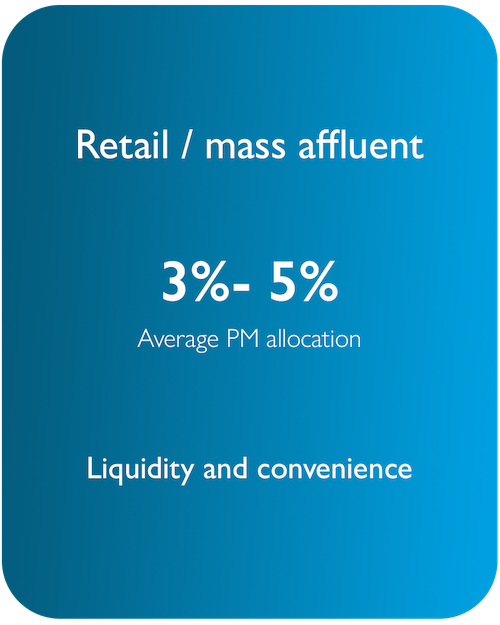
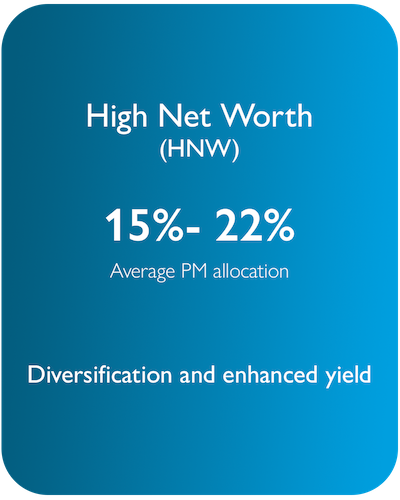
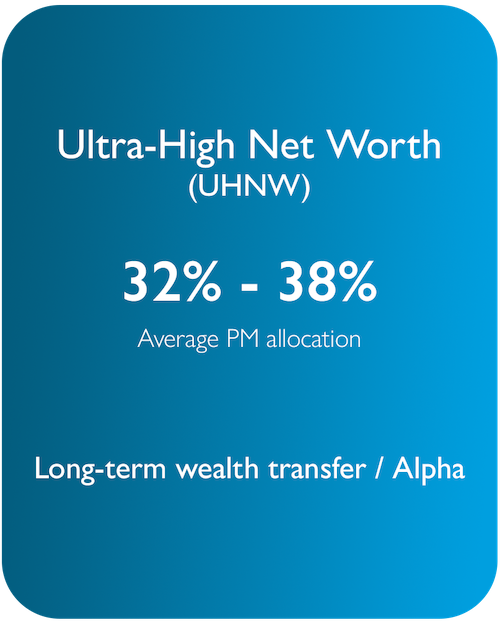
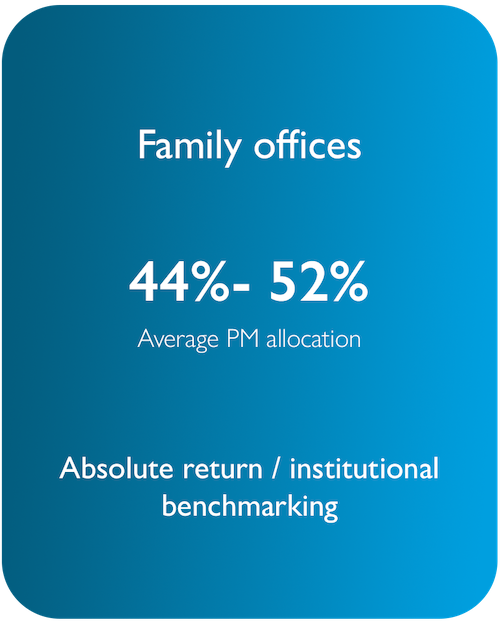
The pattern is unambiguous. Every step up in investor sophistication corresponds with a higher allocation to alternatives not because sophisticated investors accept more risk, but because they understand that genuine diversification requires exposure beyond public markets.
For South African investors, the gap is particularly striking. Local allocations to alternatives remain well below global norms across every wealth tier, a gap driven not by preference, but by access and education.
Speak to our distribution team about incorporating alternatives into your practice
Contact our team → -
strategic benefits of allocating to alternatives
Alternatives are not a replacement for equities or bonds, they complement them. Each asset class plays a distinct role in a portfolio, and the best-constructed portfolios use alternatives to fill gaps that traditional markets cannot: uncorrelated yield, inflation protection, capital preservation, and access to growth that occurs long before a company ever reaches a public exchange.
Whilst each strategy carries its own risk profile, capital preservation is central to how Westbrooke approaches every investment the degree of downside protection simply varies by where each strategy sits in the capital structure.
Depending on the asset class, alternatives deliver distinct and often overlapping advantages:
Growth and capital appreciationPrivate equity targets significant value creation over a longer hold periods, capturing the exponential growth phase of a business before it ever reaches a public exchange. Returns are driven primarily by alpha, the skill of the manager in sourcing, improving, and exiting businesses at a premium, rather than market movements.
Income and yieldsSenior secured private debt generates regular, contractual cash income, typically floating-rate, making it a natural hedge against inflation and rising interest rates. The yield premium over listed equivalents reflects the complexity of origination and the illiquidity of the instrument, not necessarily higher risk.
Blend of yield and growthBoth real estate and hybrid capital occupy the middle ground. Real estate delivers reliable rental income alongside long-term capital appreciation, with the added reassurance of a tangible, physical asset. Hybrid capital, secured, structured lending with equity participation, generates contractual interest income from day one, with the potential for meaningful capital upside as the underlying business grows.
Capital preservationAcross all strategies, the degree of downside protection is determined by position in the capital structure and the skill of the manager. The capital stack, from most to least protected, works as follows:
- Senior secured debt sits at the top – first in line for repayment, secured against company assets, and least exposed to the performance of the underlying business.
- Preferred equity and hybrid capital sit above common equity, benefiting from a preferential return and liquidation preference whilst retaining participation in the upside of a growing business.
- Common equity sits at the bottom of the stack – last in line for repayment, but with the highest potential for capital growth if the business performs.
- Understanding where a strategy sits in the capital stack is one of the most important tools an investor has for assessing risk. A senior secured private debt position and a private equity position are fundamentally different risk propositions, even if both are classified as “alternatives.”
most protectedSenior secured debtPrivate debtRiskLower+middle of the stackPreferred equity / hybrid capitalHybrid capitalRiskModerate+least protected · highest upsideCommon equityPrivate equityRiskHigher+↑ Lower risk · higher protection Higher return potential ↓ -
considerations, drawbacks and offshore complexities
While alternative investments provide distinct advantages, they are complex instruments. Investors and wealth partners must carefully consider several factors, particularly when allocating capital to offshore opportunities:
Liquidity constraintsMany alternative investments require capital to be locked up for extended periods (ranging from 1 to 7+ years depending on the asset class), meaning investors cannot access their funds on daily notice. Capital committed to a private equity fund is typically inaccessible for five to seven years; private debt strategies typically lock capital for 6 months to 2 years. The compensation for accepting this illiquidity is the “illiquidity premium”, the additional return investors earn above listed market equivalents. As an example, across private debt strategies, this premium has historically ranged from 200 to 400 basis points above comparable public instruments. Westbrooke’s product offering comprises a combination of closed-ended and Evergreen (open-ended) structures, with the latter offering periodic liquidity windows. The appropriate liquidity profile depends on your investment horizon and cash flow requirements, both of which should be discussed with your wealth advisor before committing capital.
High minimumsHistorically, these investments require high minimum investment amounts that put them out of reach for the average retail investor. Westbrooke’s strategies are typically accessible from R1 million or £100,000, depending on the location of the strategy.
Offshore tax and exchange controlsInvesting outside of South Africa introduces complexities regarding tax structuring, utilising offshore allowances, and physically moving money across borders. South African residents have access to a R2 million single discretionary allowance and a R10 million foreign capital allowance (tax clearance required) per calendar year. Westbrooke’s investment structures are designed to be as efficient as possible for access by South African connected capital.
Regulatory impedimentsFinancial products are regulated and, when made available to South Africans, require appropriate local licensing. Furthermore, depending on the investment structure selected, financial advisors require different FSCA licensing categories in order to allocate to alternatives. The most common categories include Category 1.8 – Shares and Category IIA – Hedge Funds.
Manager selection riskThe private markets can be opaque. Unlike buying a listed index tracker, success in alternatives relies heavily on the manager’s ability to source deals, manage risk, and navigate foreign jurisdictions. Accessing top-tier global managers from South Africa is notoriously difficult without a trusted local partner.
-
looking ahead – the global convergance
According to McKinsey’s latest Asset Management report, the dominant theme for the next five years is “The Great Convergence” between traditional and alternative asset management. This is not just a marketing term; it is a fundamental restructuring of how capital is sourced, managed, and distributed globally.
For South African investors and wealth managers, the next decade will look vastly different from the last:
The rise of Evergreen structures
Historically, private markets required rigid 7-to-10-year lockups. Today, the number of active “Evergreen” (open-ended) vehicles has surged globally. Industry forecasts suggest these semi-liquid structures will represent over 20% of all private market assets within the next decade.
New innovations in access
The lines between public and private are blurring. From new Public-Private ETFs (blending 85% listed equities with 15% private credit) to the future potential of asset tokenisation, private markets are rapidly being fitted into the “pipes” of the traditional investment ecosystem.
The South African evolution
While South Africa has historically lagged global alternative allocations due to regulatory and platform (LISPs) constraints, widescale adoption is imminent. In April 2026, the SARB doubled the single discretionary allowance from R1 million to R2 million per calendar year — the first increase in 15 years and a material expansion of the capital available to South African investors for offshore allocation without tax clearance. LISP platforms are increasingly accommodating alternative structures, and collaboration between traditional asset managers and private market specialists is growing. The direction of travel is clear.
-
unlocking global private markets for south african investors
Founded in 2004, Westbrooke has deployed more than R23 billion across 560+ private transactions in South Africa, the UK, and the USA. We invest our own capital alongside our investors in every transaction — as manager, underwriter, and co-investor.
Our product range is built specifically for South African investors: Evergreen vehicles with periodic liquidity, closed-ended funds and co-investments where appropriate, locally registered Qualified Investor Hedge Funds, and offshore Actively Managed Certificates compatible with local portfolio structures.
chapter 1 · contents
This chapter covers eight topics. Click any section below to jump directly to it, or scroll through at your own pace. Estimated reading time is 25 minutes.
⏱ estimated reading time · 25 minutes
what is an alternative investment
Alternative investments are best explained as any investment that falls outside the traditional asset classes of publicly traded equities, bonds, and cash. They offer a unique mechanism to generate yield, capture growth and diversify away from standard market volatility.
Alternatives are primarily available in the private markets, meaning they are not listed on public exchanges like the JSE. Access to quality alternative strategies has historically been restricted to sovereign wealth funds, large pension funds, and endowments, institutions with the scale, expertise, and networks to originate and underwrite private transactions. That structural barrier is what this Institute, and Westbrooke, exist to address.
Key characteristics and benefits
Because alternative assets are not listed on public exchanges, their performance is not directly tied to daily market sentiment or short-term price fluctuations. This means they can behave differently from equities and bonds during periods of volatility, providing genuine diversification rather than simply adding more of the same risk to a portfolio.
Well-managed alternative strategies have historically outperformed public market equivalents over the long term. Two distinct drivers explain this:
- The first is alpha- The primary source of superior returns in private markets is alpha, the skill of the manager in sourcing, improving, and exiting investments that the public market cannot access or price correctly. As an example, a top quality private equity manager does not merely buy a business; they actively improve it, grow it, and position it for a premium exit.
- The second is the illiquidity premium: the extra yield investors earn in compensation for committing capital for a defined period, because alternative investments are not freely tradeable, investors are rewarded for that constraint. Together, these two drivers — alpha and illiquidity premium — explain the long-term return advantage of private markets.
Unlike listed investments that can be bought or sold on any trading day, alternatives typically require capital to be committed for a defined period, often three to ten years depending on the strategy. This is not a drawback; it is the mechanism through which value is created, and the illiquidity premium is earned. Investors should approach alternatives as a long-term allocation, not a liquid holding.
Alternative investments require genuine expertise to source, structure, manage, and exit. This is not passive index exposure; it is active management in the truest sense. The quality of the manager is therefore the single most important variable in determining outcomes.
a closer look at key alternative asset classes
Importantly, each of these asset classes can be accessed both locally and globally, providing South African investors with offshore diversification and hard-currency capital preservation.
| Asset class | Primary goal | Risk profile | Investment horizon |
|---|---|---|---|
| Private debt | Predictable income and capital preservation | Lower (senior secured sits at the top of the capital structure) | Short to medium term (typically 2–5 years) |
| Hybrid capital | Income generation with limited capital growth upside | Moderate (subordinated to senior debt, but senior to equity) | Medium term (typically 3 to 5 years) |
| Real estate | Tangible asset backing, inflation-linked yield, and capital appreciation | Moderate to high (dependent on sector and leverage) | Medium to long term (typically 3 to 7 years) |
| Private equity | Significant capital growth and absolute return | Higher (equity position — last in line for repayment but highest upside) | Long term (typically 5 to 7+ years) |
private debt
An investment strategy where non-bank lenders provide loans to support the financing objectives and requirements of businesses The capital might be used to fund growth, acquire a competitor, or support operations. Loans are usually secured against company assets such as property or trade receivables and generate a regular cash yield paid to investors throughout the life of the loan.
Provides investors with a predictable, contractual income stream, with lower correlation to listed markets, more pricing stability, and higher absolute value returns. Whether deployed locally or offshore in hard currency, Private Debt offers strong capital preservation and an excellent hedge against inflation / rising interest rates, as loans are often secured against company assets (senior secured debt – which means a lender has first claim on borrowers assets) and feature floating interest rates.
private equity
Taking an ownership stake in private companies, businesses that are not listed on any public stock exchange. Private equity funds acquire these companies, actively work to improve and grow them, and ultimately sell them at a profit, returning capital to investors.
Private equity managers take an active role in growing and improving the businesses they buy. Unlike listed equity investing, where returns are largely driven by market movements, private equity returns are generated through genuine value creation: improving operations, accelerating revenue growth, strengthening management, and positioning the business for a premium exit. The manager is not a passive observer they are active owners with skin in the game. The world’s most valuable private companies from global technology businesses to healthcare innovators are choosing to stay private longer, meaning the most significant phase of their growth never reaches the public stock exchange. Private equity is how investors access that growth.
hybrid capital
A debt-led investment strategy that blends the downside protection of structured lending with equity upside participation. Hybrid Capital sits above common equity in the capital structure while offering the potential to share in the growth of the underlying business. It sits above common equity in a capital structure, while retaining the ability to share in value creation if the business performs well.
Offers companies flexible growth capital without immediately diluting the owners’ shares. For investors, it provides contractual interest income (like debt) with the potential for capital upside (like equity) — a return profile that neither pure debt nor pure equity can deliver independently. This combination provides meaningful diversification across both local and global markets.
real estate
Direct investment in physical properties (commercial, residential, or specialised like logistics and student housing) rather than buying shares in a listed property stock / REIT.
A key benefit of private real estate is that the asset is highly tangible - investors can physically see it and better understand the underlying value. It provides strong physical asset backing, reliable rental income generation, and capital appreciation. Because it is not mark-to-market daily like a listed REIT, private real estate also exhibits significantly lower short-term price volatility, investors experience the economic reality of the asset rather than the sentiment of the stock market.
key benefits of allocating to alternatives
The 60/40 portfolio
For years, the traditional "60/40 portfolio" (60% equities, 40% bonds) was the gold standard. This relied on the assumption that when the values of equities fall, bonds will rise providing a natural hedge. This held true in the era of high growth and low inflation, but today we are in an environment of low growth and high inflation meaning that those asset classes are now heavily correlated.
Shrinking public markets
The number of listed companies has roughly halved since 1996, making the global addressable listed investment universe extremely concentrated. By way of example, the JSE had over 600 companies listed in 2000; today there are around 270 companies listed. The S&P 500 similarly reflects this trend, with the broader US market seeing its total number of listed companies drop from over 8,000 in 1996 to roughly 4,000 today, limiting the pool of available public investments. If you allocate 100% of your capital to public markets, you are ignoring 87% of global companies with revenues over $100 million.
Hover over data points for detailed information
Data sources: World Bank, Center for Research in Security Prices (CRSP), JSE Annual Reports, London Stock Exchange.
Companies stay private for longer
In the 1990s, the average age of a company at its Initial Public Offering (IPO) was about 4 to 5 years. Today, companies are waiting 10 to 12 years on average before going public. For example, Amazon was 3 years old at its IPO in 1997 whereas Uber was 10 years old when it IPO’ed in 2019. This change means the exponential wealth creation that historically took place on the stock market is now realised in the private markets.
Hover over data points for detailed information
Sources: Professor Jay Ritter, University of Florida IPO Database and PitchBook Data, Inc.
Concentration risk
The Magnificent 7 (Apple, Microsoft, Alphabet, Amazon, Nvidia, Meta and Tesla) are dominant US tech-focused stocks that comprise roughly 34% of the S&P 500 market capitalisation and accounted for over 40% of the index’s total return in 2024. This significant weight in the index creates high concentration risk. Similarly, on the JSE, gold / platinum miners and big tech conglomerates (like Naspers / Prosus) make up a disproportionate percentage of the JSE top 40 index.
The data above describes a public market that is shrinking, concentrating, and increasingly correlated. For investors seeking genuine diversification — and access to the growth that is now being created in private companies rather than on exchanges — private markets are not optional. They are the logical response to the structural characteristics of the world’s investable universe.
See how Westbrooke's private market strategies provide a solution to public market volatility.
View our investment calendar to see currently available investments →how sophisticated investors allocate globally
The most instructive way to understand how alternatives function in a real portfolio is to look at how the world’s most sophisticated allocators use them and at what allocation levels. The data below, sourced from KKR’s Global Macro and Asset Allocation research (2024), shows a clear pattern: as investor sophistication and wealth increase, so does the proportion allocated to private markets.
The return impact is equally clear. According to KKR’s comprehensive analysis of returns through December 2023, shifting from a traditional 60/40 portfolio to a 40/30/30 blend (incorporating a 30% alternatives allocation) improved risk-adjusted returns across every major economic cycle measured. In low-growth, high-inflation environments, the conditions most relevant to South African investors today, the performance gap is most pronounced: a 60/40 portfolio returned 0.1% p.a. whilst the blended portfolio returned 2.1% p.a. The driver is not simply higher returns; it is reduced correlation. When equities and bonds move together (as they did materially in 2022), alternatives with independent return drivers provide the portfolio ballast that traditional diversification no longer can.
portfolio comparison
Hover over data points for detailed information
According to global wealth data (KKR Global Macro & Asset Allocation, 2024), here is how the world’s most sophisticated investors are currently allocating:
The pattern is unambiguous. Every step up in investor sophistication corresponds with a higher allocation to alternatives not because sophisticated investors accept more risk, but because they understand that genuine diversification requires exposure beyond public markets.
For South African investors, the gap is particularly striking. Local allocations to alternatives remain well below global norms across every wealth tier, a gap driven not by preference, but by access and education.
Speak to our distribution team about incorporating alternatives into your practice
Contact our team →strategic benefits of allocating to alternatives
Alternatives are not a replacement for equities or bonds, they complement them. Each asset class plays a distinct role in a portfolio, and the best-constructed portfolios use alternatives to fill gaps that traditional markets cannot: uncorrelated yield, inflation protection, capital preservation, and access to growth that occurs long before a company ever reaches a public exchange.
Whilst each strategy carries its own risk profile, capital preservation is central to how Westbrooke approaches every investment the degree of downside protection simply varies by where each strategy sits in the capital structure.
Depending on the asset class, alternatives deliver distinct and often overlapping advantages:
Private equity targets significant value creation over a longer hold periods, capturing the exponential growth phase of a business before it ever reaches a public exchange. Returns are driven primarily by alpha, the skill of the manager in sourcing, improving, and exiting businesses at a premium, rather than market movements.
Senior secured private debt generates regular, contractual cash income, typically floating-rate, making it a natural hedge against inflation and rising interest rates. The yield premium over listed equivalents reflects the complexity of origination and the illiquidity of the instrument, not necessarily higher risk.
Both real estate and hybrid capital occupy the middle ground. Real estate delivers reliable rental income alongside long-term capital appreciation, with the added reassurance of a tangible, physical asset. Hybrid capital, secured, structured lending with equity participation, generates contractual interest income from day one, with the potential for meaningful capital upside as the underlying business grows.
Across all strategies, the degree of downside protection is determined by position in the capital structure and the skill of the manager. The capital stack, from most to least protected, works as follows:
- Senior secured debt sits at the top - first in line for repayment, secured against company assets, and least exposed to the performance of the underlying business.
- Preferred equity and hybrid capital sit above common equity, benefiting from a preferential return and liquidation preference whilst retaining participation in the upside of a growing business.
- Common equity sits at the bottom of the stack - last in line for repayment, but with the highest potential for capital growth if the business performs.
- Understanding where a strategy sits in the capital stack is one of the most important tools an investor has for assessing risk. A senior secured private debt position and a private equity position are fundamentally different risk propositions, even if both are classified as "alternatives."
considerations, drawbacks and offshore complexities
While alternative investments provide distinct advantages, they are complex instruments. Investors and wealth partners must carefully consider several factors, particularly when allocating capital to offshore opportunities:
Many alternative investments require capital to be locked up for extended periods (ranging from 1 to 7+ years depending on the asset class), meaning investors cannot access their funds on daily notice. Capital committed to a private equity fund is typically inaccessible for five to seven years; private debt strategies typically lock capital for 6 months to 2 years. The compensation for accepting this illiquidity is the “illiquidity premium”, the additional return investors earn above listed market equivalents. As an example, across private debt strategies, this premium has historically ranged from 200 to 400 basis points above comparable public instruments. Westbrooke’s product offering comprises a combination of closed-ended and Evergreen (open-ended) structures, with the latter offering periodic liquidity windows. The appropriate liquidity profile depends on your investment horizon and cash flow requirements, both of which should be discussed with your wealth advisor before committing capital.
Historically, these investments require high minimum investment amounts that put them out of reach for the average retail investor. Westbrooke’s strategies are typically accessible from R1 million or £100,000, depending on the location of the strategy.
Investing outside of South Africa introduces complexities regarding tax structuring, utilising offshore allowances, and physically moving money across borders. South African residents have access to a R2 million single discretionary allowance and a R10 million foreign capital allowance (tax clearance required) per calendar year. Westbrooke’s investment structures are designed to be as efficient as possible for access by South African connected capital.
Financial products are regulated and, when made available to South Africans, require appropriate local licensing. Furthermore, depending on the investment structure selected, financial advisors require different FSCA licensing categories in order to allocate to alternatives. The most common categories include Category 1.8 – Shares and Category IIA – Hedge Funds.
The private markets can be opaque. Unlike buying a listed index tracker, success in alternatives relies heavily on the manager's ability to source deals, manage risk, and navigate foreign jurisdictions. Accessing top-tier global managers from South Africa is notoriously difficult without a trusted local partner.
looking ahead - the global convergance
According to McKinsey’s latest Asset Management report, the dominant theme for the next five years is “The Great Convergence” between traditional and alternative asset management. This is not just a marketing term; it is a fundamental restructuring of how capital is sourced, managed, and distributed globally.
For South African investors and wealth managers, the next decade will look vastly different from the last:
The rise of Evergreen structures
Historically, private markets required rigid 7-to-10-year lockups. Today, the number of active “Evergreen” (open-ended) vehicles has surged globally. Industry forecasts suggest these semi-liquid structures will represent over 20% of all private market assets within the next decade.
New innovations in access
The lines between public and private are blurring. From new Public-Private ETFs (blending 85% listed equities with 15% private credit) to the future potential of asset tokenisation, private markets are rapidly being fitted into the “pipes” of the traditional investment ecosystem.
The South African evolution
While South Africa has historically lagged global alternative allocations due to regulatory and platform (LISPs) constraints, widescale adoption is imminent. In April 2026, the SARB doubled the single discretionary allowance from R1 million to R2 million per calendar year — the first increase in 15 years and a material expansion of the capital available to South African investors for offshore allocation without tax clearance. LISP platforms are increasingly accommodating alternative structures, and collaboration between traditional asset managers and private market specialists is growing. The direction of travel is clear.
unlocking global private markets for south african investors
Founded in 2004, Westbrooke has deployed more than R23 billion across 560+ private transactions in South Africa, the UK, and the USA. We invest our own capital alongside our investors in every transaction — as manager, underwriter, and co-investor.
Our product range is built specifically for South African investors: Evergreen vehicles with periodic liquidity, closed-ended funds and co-investments where appropriate, locally registered Qualified Investor Hedge Funds, and offshore Actively Managed Certificates compatible with local portfolio structures.